Faster hindcasts. More time for analysis.
Purpose-built modelling infrastructure for offshore wind metocean studies.
20 October 2026, written by Andrew Watson


20 October 2026, written by Andrew Watson

What if a 50-year, site-specific wave hindcast for offshore wind design took just over a day instead of a week? That is what we are working towards at MetOceanWorks, with a significant investment in new modelling infrastructure built around the way our models actually run.
Reliable metocean data underpins almost every offshore wind design decision, from extreme wave and fatigue loads to foundation sizing, cable routing and installation windows. A good design-basis hindcast means high-resolution modelling of the site and its local bathymetry over several decades, validated against measured data, refined and re-run. Every iteration builds confidence, but every iteration also requires significant computing power.
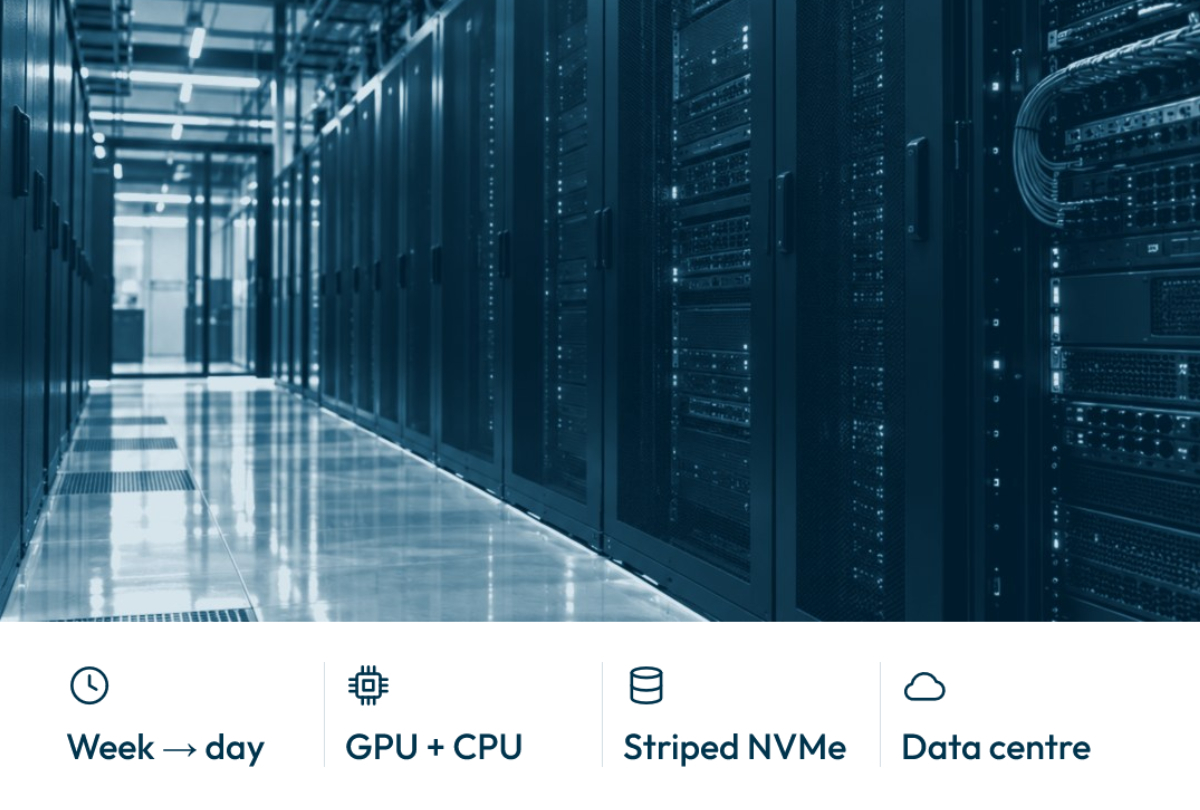
We are moving from a conventional HPC setup to purpose-built servers, designed around where the time in a hindcast really goes. Key highlights include:
We expect output-heavy 50-year hindcasts to drop from around seven days to just over one, with less storage-intensive runs about three times faster. Every model run will log its own timings, allowing us to measure performance, identify bottlenecks and continually improve how we use the system.
"Quality in metocean work comes from iteration: calibrating, testing sensitivities and validating against measurements until the data can be relied on," said Andrew Watson, Managing Director at MetOceanWorks. "This investment means we can do more of that within the same programme, or deliver projects faster when deadlines are tight. The less time we spend waiting on models, the more time we can spend on analysis."
If you are planning metocean work for an offshore wind project, we'd be happy to discuss what this additional modelling capacity could mean for your programme.